Homeschool 2021/2022 School Year Choices {5th, 3rd, 1st, and K}

This homeschool year, we are starting slowly. This is the first year we have taken a full blown summer break … we have done maybe a week’s worth of school since the end of May, and filled some time with lap books and other fun schooling activities. We’ve really taken off the majority of days for pool time (because I just can’t resist!), gardening time & family trips; and we have loved every minute of it!

Homeschool Curriculum Choices 2021

Our main core as a family this year will be continuing through Sonlight Core D (Bible, History, and Read Alouds), which is American history. When we finish this core, we will move on to Core E, the second half of American history.  After doing several years of wold cultures and world history, we are very much savoring American history. I’d like to focus on President’s and state capitols this year. There are so many great read aloud, and readers for US History. Just not enough hours in the day for all the books!

I am also finishing reading through the P4/5 Core with my youngest 2. They will be K and 1st this year; they are less than 2 years a part, but one is a fall baby and one is summer, so they’re close in grade levels. We made the choice a long time ago to keep our fall babies back a grade (they don’t meet most cut offs anyway, and like many states we aren’t required to school until age 7). We are very happy with that decision; but I like them being the older in their “grade” for the purpose of Co-op, sports, and church activities. I will start Core A with them at naps and bedtime once they finish P 4/5.

Math- We will be using Christian Light Education for our math, as always. My kindergartener will be using their K2 books, and I hope this bridges the gap between K math and 1st grade math for her. I will probably add in Saxon K worksheets  for her as well. I think CLE K2 combined with some math games and a little Saxon K, will be a fine math foundation.

Science- I just haven’t made up my mind here. I really love Apologia’s science programs. We would do the Anatomy and Physiology  if we go with Apologia … we really need to complete the Sonlight Science for Core D *but* every time we go to do the science, my kids already know  everything we are discussing (thanks Wild Kratts), so I just feel blah continuing with it. I know I don’t have to finish it, but I hate to leave it incomplete; also, it isn’t only animals and biology. Core D Science covers lots of other fun topics, so I should just persevere.

We will also add in No Sweat Nature Study again. We have really enjoyed these classes, and are building some great nature journals.

Language Arts- My beginning readers (K and 1st) will be using AAR plus The Good and the Beautiful. My older 2 will continue with The Good and The Beautiful, in levels 3 and 5. This includes spelling, some phonics, grammar, some writing, and geography. The 1st grader is a great reader, so lessons with her are pretty smooth. The K wants to read so badly, and was killing all the CVC words we practiced on our Florida vacation (during snuggles in the morning). So we are looking forward to her reading this year.

We add in Explode the Code, and Wordly Wise to our language arts. My children love both of these, and it does improve their skills, along with giving extra handwriting practice. I like them because of all this, plus they provide independent work for my children; so while I work with one student on language arts or math, the others have some independent work that keeps them on task.

Handwriting- We begin with Handwriting Without Tears, and after the PreK and K books, we move on to A Reason For Handwriting book K and then A. I like giving my children lots of good handwriting practice. They usually fly through both K books, but then Book A isn’t as difficult and they’re better readers by then, making the copywork easier. My 3rd grader is in their first cursive book. My 5th grader has done so many handwriting copyworb books, and she likes them so much. This year I got her the Memoria Press cursive book … I think it is a poetry copywork.

Extras- We are doing logic this year, with some workbooks I found on Rainbow Resource. They do problems logic in their math, but this is just extra practice; my husband wanted to be sure they were hitting logic, so we are going to try it this year.

My 5th grader is doing French from Memoria Press, which she is sooo excited about. I think I couldn’t given it to her for her birthday and she’s been just as excited. We are adding in some new sets of Brain Quest for fun, Fandex Presidents and States, and Kanoodle for a little brain teaser game.

We are using the Answers For Kids boxed set for our Bible discussions, along with the Heroes of History and Christian Heroes added to our morning basket time.

We are praying over our homeschool year that each step taken is led by the Lord, and that our words glorify Him. I am truly grateful for the blessing of our homeschool journey, even during the hard days (especially) or mornings when life feels heavy, I know the relationships we are building are worth it. At the end of the day, the math and reading, and science topics don’t save my children. Jesus does. And while we love learning (just one reason we homeschool), learning to love each other and serve one another on really hard days, is maybe one of the best things I can give my children. Or at least show them day in and day out.

I hope yall found this helpful. If you have any questions about what we do, or why/how we do it, let me know and I can go more in depth for you!

Are yall ready for the school year? Or school week? Or school semester/term?  You’ve got this mamas!


Disclaimer: Some links on this blog are affiliate links; when you use those links you help support my family, at no additional cost to you.  Thank you!

Not Back to {Home}school-first day memories

August 16 was our first day “back to homeschool”, but it looked nothing like what most people would consider a school day. The joy of homeschool?- it doesn’t have to! We spent the day finishing the de-stemming process of this year’s elderberries, and then turned them into elderberry syrup.( I can share that recipe, soon!)

I’m not a super fun crafty mama that makes all the fun things, or plans events for the first day of homeschool.

Like most things we do around here- we try to keep it simple. We have a homestead, and there is a lot to get done this time of year (which is also why I usually school year round and take a short break in August for harvesting. But this year was just a bit different).

Most years we enjoy box day a week or 2 before school begins- this is the day that we open all our homeschool orders, and peruse the books, games, and curricula we will explore together for the next year.

Homeschool Box Day 2021

Then I get everything organized and put away for our first day. This includes organizing our Sonlight core books, tearing apart workbooks to be organized by weeks, and making everyone’s laminated weekly routines so they know what to cover each day.

The first day of our routine is usually just a school day. Our box day gets my kids pretty excited for the new school year, so we don’t typically have problems starting our homeschool days. But there are always small growing pains (mostly for me) as we get the routine down, especially on years we add a new student to the mix.

We have a rhythm that works well most days:

  • 530/600 Mama has coffee and Jesus time cause this gig requires a lot of Jesus 😉
  • 700 everyone out of bed- bedroom & farm chores
  • 730 breakfast and get baby up
  • Then I walk (or workout) while the kids play first thing, or do something farm related like massage a goat’s bloated rumen until she is better, or put up tomatoes for the freezer because they’re everywhere, or chase cows down because they escaped.
  • Then we all meet back for morning basket together
  • From there we move to table work
  • after that is lunch (usually about 1130/12:00)

Morning basket can take us a while, we do a lot of reading. Like. A lot. But that’s just how we roll; we love books and our core curriculum is literature based, so it just takes a while to get through it all. My kids color while we read and they could sit for hours to listen and discuss, I think.

This year our first “homeschool routine day” was on a Tuesday, so we met daddy for Taco Tuesday after work, and took our first day of school pics with nice clothes on ? normally it would just be pajamas…

We are all excited for the school year, learning new things, and reading all the books! The Kindergartener is especially enthusiastic for the start of her first real school year.

What is your first day of homeschool tradition(s)?


Disclaimer: Some links on this blog are affiliate links; when you use those links you help support my family, at no additional cost to you.  Thank you!

Mid Homeschool Year Update{2018/2019}

You’ve been asking, so here it is:

We have made it to March, which is actually pretty far past mid year. I will break things down per student/age and what we do as a family.

This is going to look like … a lot. I think I say that all the time. We loop schedule our extras, so extras are on a continuous loop that we don’t fret over doing every single day. Because my 8 year old is a very independent learner in most areas, she has a lot of independent-learning-style subjects, as you will see.

Keep in mind we do a LOT of oral learning via reading, memory work review, and research interest led learning. I have each child tell us what they’re learning about so everyone can learn from everyone, in a school house style environment.

Mid/End of Year Homeschool Learning Update

In our homeschool, like most, learning time isn’t confined to the table, so while we do the things listed below, learning expands over our entire day, our entire life.

Family Learning:

  • Sonlight Core B: History, read alouds, and Bible reading. We have LOVED the read alouds this year! (I paired up the SL read alouds with different Arrows from Brave Writer for my oldest, to make a LA program.)
  • Free Writing: We journal and freewrite as part of our family culture. All of my kids enjoy writing stories, and are especially into poems right now. Sometimes I choose something the kids have written to edit and revise together, so they can make their favorite freewrite into a polished piece. Most of these are in their personal journals or school writing notebooks. My husband often gets them journals when he travels to different places/countries, and they are filled quickly! I keep them in hope chest downstairs when they are full.
  • Science/Nature Study: We are currently working from Anatomy of Nature and Anatomy of a Farm; from these pages I choose a topic to study. We recently did honey bees and butterflies. Soon we will begin pond life, because spring is the perfect time to study from our pond! We have also touched on anatomy this year, and a few other topics as interest has arisen.
  • Handicrafts: We do a LOT of handicrafting around here. Almost 100% of it is child led-they have free access to most of our crafting supplies, so crochet, hand sewing, embroidery, whittling, wood working (simple with hammer and nails/saws) ink making, and the list goes on, are done by them during their free times. Thankfully, homeschool allows for a LOT of free time; boredom = creativity and problem solving.
  • Art: We follow a few favorites on youtube and online for art.  Our Read Aloud Revival premium access membership has live artist workshops we attend to learn to draw with wonderful illustrators and authors, these are my kids’ favorites! We also enjoy ChalkPastel.com’s tutorials, and may add their membership to our wish list next year!
  • We use the IXL app on the ipad (read my review here) for extra learning practice because they love it. Because I limit what they are allowed to do online for now, this is something special and educational for them =)
  • Games are part of our schooling and family time. We love games like 4 Way Count Down, uno, and Pass the Pigs. Any GameWright game is a hit here (I don’t do super complicated games). We add family games via Christmas gifts, birthdays, spring basket, and of course, homeschool box day!
  • Morning Basket: (AKA any time of day basket) This is just a fancy homeschooler term for circle time… you know, the thing we all did in preschool through elementary school? Calendar, read a book, learn about something new, review something, sing songs, listen to music, read poetry, do a fun activity, share knowledge, and/or handicrafts? Yep. That’s morning time basket.
  • Read Aloud Revival premium access membership: I cannot emphasize enough how much I love this resource! We missed this months events, due to illness (the flu had us sleeping/resting a LOT), but you can see the schedule

8 Year Old/2nd Grade

Lady works on different levels, anywhere from 2nd+; we still struggle with reversals but writing and spelling continue to improve with cursive and lots of oral practice. Numbers and math operation orders can be difficult with reversals, including reversing math signs. But she knows her stuff and likes oral math challenges against her little brother 😉

  • LA/Writing: We are using Brave Writer Arrows for copywork, and supplemental focus areas (in grammar and spelling), as a literature based approach. We are finishing a Narnia Arrow, because we read, The Lion the Witch and The Wardrobe together this winter, and will continue the series through part of spring. All of my kids have just loved this, as have I (since I never read the whole thing as a child-fantasy wasn’t my favorite).
  • Reading: Along with the Arrows that go to read alouds, we are also working through AAR 3. This is not something we do often, because she is such a great intrinsically motivated reader. She needs more emphasis in spelling, so we do way more spelling practice than reading at this time. She does read aloud to me throughout our daily life, a LOT, so we call that reading =) We mostly use AAR when we “do” reading, because she really likes reading the readers to me-haha. At this point, the Arrows from Brave Writer are really enough for her reading and copywork.
  • Spelling: We are using AAS Level 2 with resources from Level 1
  • Vocabulary: We really enjoy the Wordly Wise books, especially their crosswords puzzles and activities found in them. She has learned a LOT from these.
  • Grammar: Along with the grammar topics discussed/pointed out in our Arrows, we are using Easy Grammar. Lady does this independently, without much help from me. We apply what she learns when writing spelling sentences, journaling, freewrites, etc.
  • CLE Math: Lady is working through grade 2 CLE math. We use Saxon math worksheets as a supplement-FYI-I do NOT have her do every page from Saxon. We use the even lessons, sometimes skipping some lessons between. Saxon and CLE are similar on levels, but each approaches their questions and answers differently, and I like this! I feel like it gives her a different way to approach math, and Saxon is good about reminding us to get our hands-on learning things out for practice! Sometimes we don’t even use the worksheet, but just set up hands on learning activities that fit what’s on the paper. It is really just a jumping off point for me, as well.
  • Extras: We loop extras throughout the week. Lady uses CLE’s geography and science workbooks. I am not a huge advocate of workbooks, however, the CLE books are very nice! The illustrations are simple, and very … nature study-ish; they’re lovely and fun to color with pencils if you have a art lover on your hands like I do. She is a visual and audio learner, so reading is one of her best learning super powers, however, she needs practice writing, which the CLE books provide. They bring us both joy, so we stick with them. I also find they are great for her to open on her own when I need to work independently with another child; I love hearing about what she’s learned in these!

Regarding workbooks– These are going to depend on your family’s learning style. Each child is different; some will be bored to death with workbooks! My 4 year old loves them, my 8 year enjoys them, my 6 year old is reading independently enough to do his math alone, and some language arts, but isn’t in love with workbook style learning (with the exception of CLE Bible 1). I am 100% okay with that, so for his age and development we keep them to a minimal.

6 Year Old Boy/Kindergarten

  • Language Arts: We are using AAR Level 2 for his reading. He just finished level 1.
  • LA Extras: We are using The Good and The Beautiful Level 2 for him as well. This is a beautiful curriculum that includes grammar, spelling, and reading, however we don’t use it that way. I will try to make a video on how we implement the program, but we use their spelling list for sight word spelling/common words, and enjoy their readers for extra practice. I really LOVE their practice pages and the grammar concepts covered. This is working better for him than Easy Grammar, at this point. Easy Grammar is a bit more dry and fill in the blank (again, my 8 year old begs to do this!), and that just isn’t Mister’s jam.

**I do not believe there is ever such a thing as too many books or readers at appropriate levels-hence me using so many different ones. Variety is the spice of a nurtured reading life haha**

  • Spelling: He is doing AAS 2 with his sister. Mister is a natural speller, and things that are harder for my 8year old (due to dysgraphia symptoms) are easier for him right now, so they’re actually in the same level.
  • Math: He is using CLE math 1. Math is super easy for this boy, he flies through his books and often asks for more than 1 lesson. He loves dictation word problems, writing math problems, and speed drills.

4 Year Old Girl/PreK

  • This one tags along, and we are slowly going through AAR 1. She can read CVC words pretty well.
  • We use Handwriting Without Tears; next year she will move into A Reason for Handwriting like the others have.
  • Math is Math Eggs K, she loves this book.
  • We also are using Rod and Staff Preschool Set, because *I* love them. They’re so simple, much like the CLE books we use, but they allow her some independent style work, which she likes.

The toddler tags along, of course. As summer creeps upon us, I won’t be doing as many “extras.” We strip down to basics when the weather is nice to allow lots of outside play-we have a farm that is blooming into spring and full of life, so we need to enjoy it while it lasts!

Disclaimer: Some links on this blog are affiliate links; when you use those links you help support my family, at no additional cost to you.  Thank you!


Christian History Audio Drama for the Whole Family {a review}

Heirloom Audio Logo

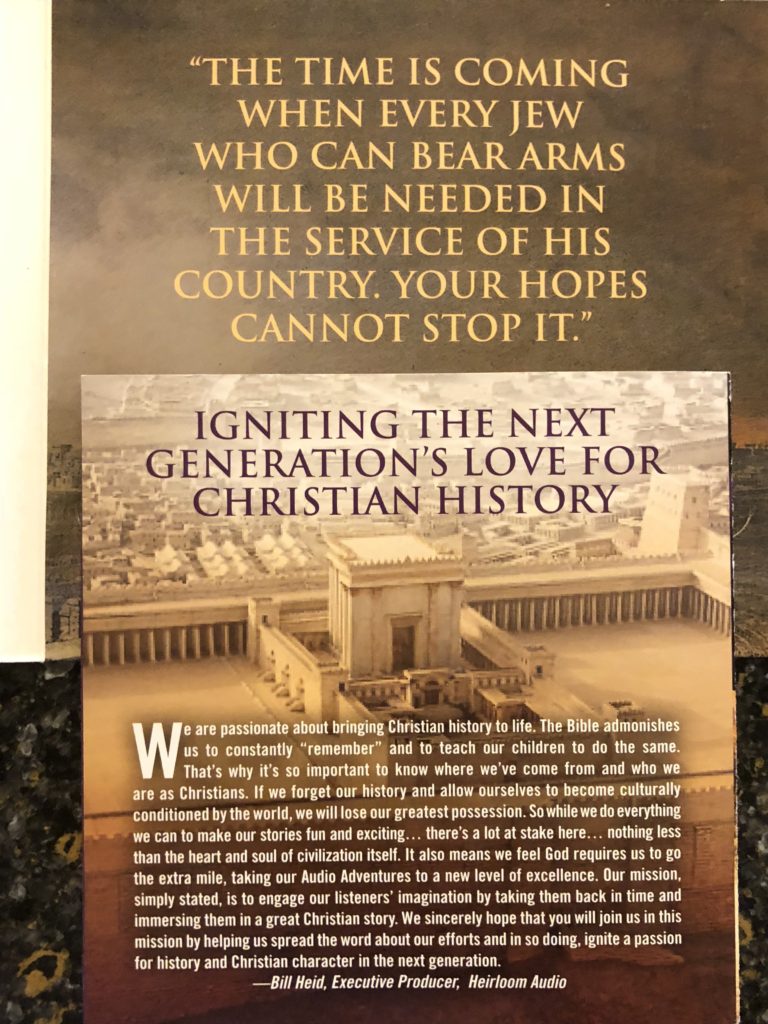
During our morning time, we have been enjoying the latest publication, For The Temple from Heirloom Audio. My children have LOVED this listening experience. (You can see our past Heirloom Audio review HERE)

We reviewed the 2 disc physical CD set, as well as the digital PDF study guide.

The guide is full of details and comprehension/deeper thinking questions found under sections: Listening Well, Thinking Further, and Defining Words. You will find each section has its own content for each chapter of the story. Thinking Further includes activities, such as googling images/information from history that pertain to the story and reading Bible passages for comparison/historical context. The study guide itself is beautiful and takes the adventures of  G.A. Henty to a new educational level; meant to help parents have juicy conversations with their children, it can also be used independently by older students. (My 8 year old enjoyed using it on her own, while the others used it orally with me.)

For the Temple {GA Henty Adventures}


*What It Is * How We Used It* What We Think*

Heirloom Audio is one of our favorite companies to support- you can read more about who they are HERE, which outlines what they believe, and how they get these great history stories. I love that their stories are wholesome, being safe for my kids to listen without me needing to know every detail before pressing play.

Based on the book by G. A. Henty, For The Temple is another gripping, family entertainment, audio drama from Heirloom Audio. Though John wants to stay home and follow in his parents’ footsteps as a farmer, he knows God is calling him to fight the Romans. He shows great leadership skills and integrity while defending the Jews, rescuing innocents, and encouraging the men in his army. Later, we see God has been preparing John, as he is called to defend God’s people once again in Gamara.

What began as the story of a young boy, silly and not ready for marriage, turned into a hero’s story of brave risks, integrity, and Godly intent. As John realizes he has been called by God to lead an army against a great threat, we see great excitement and purpose in his life, which God saw all along (of course). He overcomes not only defeat in the field, but also slavery, as God’s hand writes his life story. In the end we rejoice with John and his family as they accept Christ and become followers of Yeshua.

This is so much like our own lives- we have plans, feel our personality is best suited for one thing or another, and yet God sends us through trials, introduces us to people we may have never known … all so we can do His work and come to know Him better.

He equips the called.

For The Temple Audio Production

My 8 year old’s favorite part of For The Temple:

“While the Romans were trying to reach the temple, John took a lot of fishing boat on the Sea of Galilea, and everyone held torches to make the Romans think they were a large army-he said if it worked for Gideon, it could work for them. Another part I liked was when the Romans were waiting for the people to starve inside the city, because the Jews couldn’t reach food and water without going outside the walls. But John was brave and fought the Romans with swords, even though he was out numbered. But I don’t think John knew Jesus, because he didn’t believe, at first, that He rose from the dead.”

The production team, acting cast, and recreation of this original G.A. Henty story is top notch family entertainment. We like to turn on the audio each morning during morning time, but be warned- it can be hard to turn it off! It is also a great independent listening time for the kids while mama gets a shower, tidies up, or prepares a meal.

Beautiful life lessons and Biblical character traits are threads throughout all the Heirloom Audio stories, and that is no different in For The Temple. We meet characters from the Bible and how their stories would have impacted people during this era of history. Even the youngest of listeners can recognize those people, and see the impact Jesus’s death would have had during that time.

For The Temple Audio Production

—I want to add, that exploring their website is worth the effort! The “Kid’s Corner” and other resource links are safe for young children, and full of family fun! You will find videos, links, quizzes, and more!

Connect with Heirloom Audio:

Read more reviews from the Crew by clicking the banner below:

For the Temple Reviews


Disclaimer: Some links on this blog are affiliate links; when you use those links you help support my family, at no additional cost to you.  Thank you!


Live Online Violin Lessons for the Entire Family {plus a special offer & review}

Online Family Violin Lessons $39 a month!

My oldest has been playing violin for a while; we have attended lessons on and off between moves. This summer, at a time in our homeschool and family life when things were just too hectic-we really needed a slow down of running from place to place- we were blessed with an opportunity to review a Family Subscription to Live Violin Classes from Practice Monkeys. My 8 year old has been using Practice Monkeys for a little over 3 months, plus had an assessment (which determines if the student ready to move up to the next level/where you are).

We are thoroughly enjoying this program!

About Practice Monkeys Family Violin Lessons

Practice Monkeys is an online violin program perfect for the entire family! Your membership includes classes and practice resources for all the members of your family. Mrs. Sarah is a wonderful, smiling, attentive teacher that loves hearing and helping her students play. Everything you need is found in your Treehouse online, and Mrs. Sarah is very helpful and thorough when learning about your new violin lessons.

Live Group Classes:

Membership includes live lessons 4 days a week; each class level has its own assigned time slot Monday- Thursday (ours was 4pm central). There are 4 lesson videos loaded each week that are from last week’s live lessons. So if you miss a class, have no fear! You can make it up in your own time the following week. There were weeks that we made 1-2 classes, there was a week where we made them all, and weeks we didn’t make any. Practice Monkeys is unique because of the 4 live classes each week-this is where students really get their help, Sarah gets to hear them play the pieces they’re working on, and help them with improving. She works with students individually (which in turn helps the other students in class), shows fingerings, gives examples, has students copy her, and truly teaches students to play their violin. It is very fun and beneficial!

Each level of classes is made up of all the students in that level, our level 5 class had 3-4 students attend most days. Some classes have more, some fewer, students. The live classes with Mrs. Sarah are so fun! My daughter is always smiling when we finish and eager to continue her practice.

What is Included & Navigating your “Treehouse”

You will need to provide your violin, Suzuki book, and listening CD (comes with the Suzuki book). Mrs. Sarah provides links for purchasing supplies and renting violins. We are *very* blessed to have a local violin shop where we are treated so kindly and have been able to purchase beautiful violins at very reasonable prices.

Aside from those 3 things mentioned above, Mrs. Sarah provides everything for learning violin in theTreehouse, all the way down to purchasing your assessment for promotion to the next level! (More about assessment in a bit.) Below is a sample screen shot of helps which you may see at the top of your Treehouse:

Video Examples {online violin lessons}

The Treehouse is where you find all of your videos and support between lessons. It is online, and set up step by step:

  • registration & placement for new students
  • link for attending 47 live lessons each year
  • parent orientation videos
  • student set-up, learning about violin
  • tuning your violin (I learned to tune our violin via a tuning app, y’all!)
  • 4 practice classes uploaded each week (last week’s lessons to makeup or review)
  • instructional Teaching Videos for 10 Skill Areas per Level
  • all the printable practice forms, skill sheets needed for staying on track
  • printable sight reading books, activity books, etc for helping students along

Level 4 Online Family Violin Lessons

Students are expected to practice with live classes or make up classes 4x a week, PLUS 2 fun song practices! My daughter became a little obsessed with learning her fun song and didn’t do the review she should have during the last few months. I wasn’t watching her practice sheets very closely. =/ Now that we have a good routine for placing violin practice back into our school days, we are doing a lot better! haha Mrs. Sarah is very gracious, understands life, and is firm about expectations. I *love* that! You can’t improve if you don’t practice…

Violin Practice

Assessment:

An assessment is purchased separately from classes/lessons, when you feel your child is ready to be promoted to the next level. In your Treehouse you can find the assessment form (similar to a ruberic) to make sure your child has accomplished most everything in their level. Online, you will schedule an assessment with Mrs. Sarah where she will spend 30 or so minutes listening to the student play different pieces/watching skills they’ve mastered.

During our assessment Mrs. Sarah spent a good while helping my daughter work very hard on her fingerings and scales for her fun song (which all transfer over to her Suzuki practice, too). Sometime in December we both had Come Thou Fount of Every Blessing stuck in our heads, so she just started playing with the fingerings until she got it (about 2-3 days). Mrs. Sarah helped her hear the tuning fingers for those notes and more! She’s very excited about it!

Help Classes:

If ever you need help understanding something, working through something on the violin or in the Treehouse, etc, Mrs. Sarah offers help classes for this very thing! She is always available via email, but help classes are really easier for getting help, and again, that live video help is so valuable!

We are continuing our lessons with Practice Monkeys for the intro $39 a month. I am very excited to continue and focus more on our daily violin practice routine. There are so many benefits to 4 classes a week online, with a real teacher, versus driving to lessons 30+ minutes away 1x a week. In this season especially, online lessons are such a blessing for us, and we can always add students to our membership when they are ready. I dunno … I love playing Lady’s violin, so maybe I will take lessons as well! =) Either way, this has been perfect for our family and I can only imagine it is just what other families are looking for as well.

Special Reader Offer:

Click Mrs. Sarah Van Kleeck’s smiling face below, for a special reader offer: get introductory pricing for year one’s subscription cost- of $39 a month for the entire family! Using this link locks in your price, so you can pay this super reasonable price for the lifetime of your membership for the entire family! The regular price is more, so this is a steal; offer expires February 1, 2019.

Violin Lessons Discount for Readers!


Connect with Practice Monkeys


Practice monkeys Violin lessons Online

Live Online Violin Lessons


Disclaimer: Some links on this blog are affiliate links; when you use those links you help support my family, at no additional cost to you.  Thank you!


Homeschool Video-Based Art Curriculum {a review}

We have been using Art of the Ancients from ARTistic Pursuits Inc. This is a new edition book from their Art Instruction Books with DVD and Blu-Ray series. Art is always a fun topic in our home; we have really enjoyed ARTistic Pursuits when we reviewed it in the past. This time was no different!

Homeschool Video Art Lessons K-3

K-3 Volume 2, Art of the Ancients

This beautiful, hardcover, 64 page book consists of 18 lesson, 6 of which are video based lessons focused on chalk pastels and clay sculpture. It comes with 2 discs: 1 DVD, and 1 Blue-ray Disc.

The lessons on ancient art are thorough, allow students to see creativity and life differently than they may in their own culture, and introduce new experiences in chalk pastels and clay. We already had chalks and sculpting clay on hand; we used these chalks, and this clay set. You can use any brand that you may have on hand-one lessons even suggests using sidewalk chalks outdoors!

Volume 2- Ancients {homeschool art video lessons}

There are prep notes found at the beginning of every lesson, allowing the parent or teacher to better prepare for teaching. Simple suggestions like how to set up before hand for a group (4 small children at home, anyone?), or moving the lesson outside, are just what I needed to help our lesson go smoothly.

Each lesson in Art of the Ancients gives the history of an ancient culture, and the art they used in every day life- from cave drawings and carved city walls, to more sophisticated statues and pillars, students get an intimate look at the beauty found in ancient history and it’s purpose. There are over 100 illustrations found in the course book!

After the history portion of the lesson, students will find an opportunity for a picture study- our favorite part! Here is a chance to practice some narration (for all your Charlotte Mason homeschoolers!) and pay close attention to details in art. I found that often times, my children are better at finding the details than I am! Simple prompts which ask what the children see (how many, what size, what kind/shape) or where something is hiding in the picture encourages young learners to look at details, while other questions encourage them to see the art as a whole piece.

Lastly, children create! The instructions for creating your own piece of art are easy to understand and implement. The supplies needed are listed in a box at the top of the page, followed by a brief description about the type of art, explanation of new vocabulary, and instructions of how to create.

What We Think

My children have been pleading to do art since we received our book in the mail. Each time we open the book we are glad we did! The simple history lessons are fun, meaningful, and help make history come alive. My 7.5 yo enjoys reading it for fun, and everyone loves the beautiful art found inside. Lessons are short enough to hold young children’s attention & make it easy to fit into an already full life. They are very easy on mama, not parent intensive at all, which is always nice!

My toddler watched the video lessons along with us, enjoying the clay and pinch pot-making. My 3 year old followed right along in her care free way, using chalks and clay independently, while her 2 older siblings were much more serious about their work. 😉

We have loved this program and will likely use more books from the Art Instruction Books with DVD and Blu-Ray series. Thank you ARTistic Pursuits!


Pinch Pot-making {homeschool art curriculum}

pinch pots {homeschool art}


Video Art Lessons


Chalk Pastel Art

Connect with ARTistic Pursuits

Read more reviews on this and other books from this series by clicking the banner below:


Disclaimer: Some links on this blog are affiliate links; when you use those links you help support my family, at no additional cost to you.  Thank you!

Homeschool Cursive Writing with Memoria Press {a review}

Recently, we have been using a cursive program from Memoria Press-I love so many of their products and there is always something new on my wish list. This time,we have been using New American Cursive 2 (Famous Americans).

We began learning cursive a few months back at my 7 year old daughter’s request. With a few developmental struggles (vision dysfunction) that make writing difficult, cursive has been a wonderful gift for my daughter when it comes to writing. Memoria Press’s New American Cursive 2 has been a large part of that. After learning the basic letters and connections, this book has stepped in for extra practice and fun learning!

New American Cursive 2- Famous Americans

There are a several things I love about this program, one being the ease of the letter formations. The letters are at a slight slant, extra strokes have been eliminated, and the letters are very similar in appearance to those in print which children read every day via books and on paper. This is makes it easier for them to remember what the letters look like, how to form them, and also accommodates their small hands and earlier fine motor skills. For example, a traditional F in cursive is more intricate to form with loops and curls than the F in New American Cursive. My daughter has learned writing them both ways, and prefers the New American Cursive script.

The Introduction and Teaching Guide in the first 8 pages of the student book are helpful & motivating! For a parent and/or teacher, teaching cursive can be … well, intimidating! But Memoria Press has taken that out of the equation. The simple, clear, and encouraging explanations found in this part of the book offer support:

  • ideas for extra practice
  • words of encouragement for our children
  • tips on what to focus on (progress vs perfection each time)
  • ideas for testing/grading work (including allowing the child to self-evaluate)
  • and alternative exercises to help wake up the whole brain, which is so important for fine motor skills like penmanship

Teaching cursive is so easy with this program; it is open and go! I also like that I can apply all their teaching helps to many aspects of our homeschool! Such a great reminder of all our freedoms in homeschooling.

memoria press- completed cursive page

Lesson Structure:

The beginning of this book gives a refresher on forming the cursive letters; it covers the letters themselves and their connections. There are 125 lessons total, with the spiral at the top of the book making it easy for left or right handed writers. The book is geared towards most first graders; I believe you could use it for a student in varying “grades,” based on their development.

Lessons give simple cues for the different types of connections using Mr. Meerkat, who is found throughout the book. I love that each lesson is only a page (most of the time), the instructions are simple and easy for students to follow independently, and students get to circle their best letter in many lessons-this created a sense of ownership for my daughter, taking the “work” out of writing. She loves making her “very best” letters and words.

In later lessons, students focus on different skills of cursive: slant, spacing, and size. There are gentle reminders instructing the student to focus on these areas, which is very helpful.

This book uses quotes from famous Americans like Ben Franklin, to build character and confidence. My daughter recognized many of the quotes from our studies in the past, and enjoyed writing them for practice. We used some of the quotes as reminders in our homeschool these past few weeks, which was fun.

Creative Writing

Between the practice lessons are wonderfully fun creative writing pages:

  • journaling prompts with illustrations
  • opportunities for dictation
  • capital letter usage
  • writing thank you notes
  • addressing envelopes
  • writing proper letters
  • and more!

In the back of the student book you will find reproducible pages in different line sizes. These are meant to be photo copied for extra practice at your convenience; different students have different fine motor skills. Some children will need smaller lines while others will need larger spaced lines for now.

What We Think

We have LOVED this book! My daughter often picks it up outside of school time to practice. It is relaxing for her, she looks forward to the lessons, and enjoys seeing her progress. Again, Memoria Press has brought a program into our home that is easy on my time, has built my child’s confidence, and allows independence. We will definitely continue using this book all through our summer this year, and move on to the next level when she is ready!

Connect with Memoria Press


Read more reviews on this and other Memoria Press programs by clicking the banner below!


Disclaimer: Some links on this blog are affiliate links; when you use those links you help support my family, at no additional cost to you.  Thank you!

Homeschool Spelling That Sticks! {with Memoria Press, a review}


Memoria Press has been a favorite curriculum in our home; we have enjoyed their Latin program. These last several weeks we’ve been using their Traditional Spelling II with great success and enjoyment! Memoria Press is a Classical Christian Education company that offers beautiful classical curricula and resources- they’re very well known in most homeschool circles.

All of my kids write notes and stories, or make books and cards what seems like all. day. long. Lady has been ready for more spelling focus in language arts, but because of a few struggles we needed something that included word study, application, and more intention on MY part. She is a vivacious reader, words and vocabulary are her jam, but at 7.5 years old, spelling … not so much! Piecing together ideas for practicing to go with other spelling programs just hasn’t cut it for us. That’s where Traditional Spelling II comes in!

Traditional Spelling II

This is a phonics based spelling program; it’s different than other spelling programs I’ve looked at or used. For us, Traditional Spelling II has taken exactly what we needed (phonics, routine/schedule, & activities) and applied it to spelling. Lessons include definitions, riddles, dictation, application, and color coding parts of words to create understanding of what one sees and hears to build the skill of spelling. It is to be used after a child has foundations in phonics/reading, and is for the grade 1, 2, 3 student. If you have used Memoria Press’s reading program, you probably alreday have some of the 4 required resources.

Included in our review are all required resources for Traditional Spelling II:

Just copying spelling words isn’t usually enough for most students; just as reading is so important for spelling ability, so is using and manipulating words, breaking them down and building them back like a puzzle, seeing the patterns, and practicing the vowel/consonant teams. This process which is used by Memoria Press is a multi-method approach to learning that is appropriate for young students-by using colors, dictation, riddles, and the other many word study activities, children learn using many methods of encoding!


How We Use It & What We Think

First- I cannot tell you how much we both look forward to our spelling lessons now, versus before. My daughter didn’t dread spelling before, it just didn’t stick, so she was disappointed when when couldn’t spell a words she knew she’d had in spelling. Knowing that each day we have activities laid out, ready and waiting on us, and helping my daughter encode at her level, has been a blessing for me. She enjoys the daily activities (some of which change weekly, keeping things consistent but fun), and it hits all areas of learning, allowing her to soak it all up.

Each Monday I begin by writing the words in sentences on the board, then we read them together and I go over their definitions (they will be used independently in sentences lasted in the week and thus students need to know the definitions). I pull out the phonics cards we need (card numbers are provided in the teacher’s manual for each lesson under “Teaching Overview“) and we talk about the sight words & spelling sounds, reading the words on the back of the cards that correlate with the sounds.

Memoria Press Lesson 7 Phonics Cards

The Classical Phonics book is a great phonetic resource; Lady likes flipping through this on her own for more “studying.” I’ve also been using it with my 3.5 year old for learning letter sounds; she loves it and asks for it almost daily! But the suggested use is for reading the words found within the book which follow that week’s spelling rules to increase fluency. I can give Lady the page numbers and she is able to look them up herself and read to me, creating independence and building confidence!

Next we begin the daily activities. The teacher’s manual lays out everything I need to do or say, gives card numbers for the Phonics cards, and page numbers for the Classical Phonics book. The Guided Student Work activities from the teacher’s manual are often different each day; these are done on days 1 & 2 and include riddles, filling in blanks of words, and other word practices offered each day. I either write them on my board or say them aloud and Lady writes the answer on her dry erase board.

The Teacher’s Manual is NOT overwhelming; what the teacher says is not paragraph after paragraph of mundane script. It is simple, to the point, consistent, fun, and EASY. The TM is only about as thick as the Student Book, so there is no extra “stuff” or script weighing down my part. I love this because scripted lessons can often feel boring and dry, but these definitely aren’t!

Each day after guided practice with me, she begins her student book activities which include: word sort under phonics focus (day 1), a fun/new word activity, plus the Colorful Letters activity (day 2), reading a paragraph and completing sentences (day 3), dictation word and sentence practice (day 4), and day 5 is the final “test.” Some weeks have different activities for Day 2, separate from the Colorful Letters activity- unscrambling, alphabetical order, sorting by syllables, circling word parts, etc. The various ways she uses the words keeps her interest and increases her ability to write them correctly. The other days’ activities are consistently the same, allowing more practice for important skills in encoding.

Workbook Pages Lesson 7, MP

We have been using the practice sheets as part of our handwriting/copywork. Lady is OBSESSED with cursive writing, so her student book having the cursive form of the words is a huge PLUS. She really likes to write the words in alphabetical order on her practice sheets, then write them in cursive- great meaningful practice (and all her idea).

MP Trad Spelling II

This isn’t a “write the words, take a test on Friday, and forget it next week” program. The lessons are fairly short, holding Lady’s attention, while also being intentional about how we spend our time.

I don’t want to fill our days with meaningless busywork- we need time for read alouds, tea parties, and playing in the dirt; raising chickens, and playing with baby farm animals. Short, focused lessons mean that we have more time to do all the other things we need to, and especially the things we want. I never considered spelling particularly fun in school, it was just something we did. But with Traditional Spelling II I feel like we have a purpose for spelling each week. The word study and a colorful letters portions really help us see the parts of words without too much “stuff,” required.

There are several other programs The Crew has been reviewing, you can see them on Memoria’s website here:

UnBoxing Traditional Spelling II MPress

Read more reviews by the Crew for many Memoria Press products by click the banner below:

Connect with Memoria Press:

Disclaimer: Some links on this blog are affiliate links; when you use those links you help support my family, at no additional cost to you.  Thank you!

Homeschool Weekly Wrap-Up {April 7th}

The last 2 weeks we’ve spent our days adjusting our routine. I think I’ve said it before … at least I’ve thought it-vaulted ceilings and hardwood floors make reading aloud SO. HARD. I feel like I am yelling over a toddler the entire time. At this stage everyone fusses over my lap, so we’ve moved our reading aloud to my room, on the big king sized bed where they can spread out and hear me better.

Our new routine involves mama tending to the farm chores before the kids wake, getting her workout in after breakfast ,and brain warm-ups for all the kids! Day light savings really threw me for a loop this year as far as waking early goes. I am finally getting used to it. I strive for my mornings to look like this:

  • 5:30/6am- mama wakes, breakfast for the hubs, pack his lunch, coffee with him before he leaves
  • tend to meat chicks & LGD pup outside
  • Jesus devotional & coffee with my Help Club for Moms book
  • Prep Breakfast
  • 7am Kids up, eat, morning basket
  • Kid chores and 7yo practice violin- dishwasher, waste baskets, laundry, pick up floors if not done night before
  • 8:15/8:30 Mama works out, kid brain warm-ups (videos on youtube for crossing midline)
  • 9:00 Begin read alouds in my room
  • 9:30/9:45 begin table work- each day includes Reading/LArts for each child, math, handwriting/copy work We do other activities on various days, looping them (Latin, Apologia Science we are reviewing, art, messy play, game school)
  • During that time, the tot (20 months) goes to independent play in her room, and after the 3yo has done school along with us for a while, she also goes to IP
  • 11:30 Lunch
  • 12:15 Tot’s nap, others play outside
  • 12:45 Preschooler’s nap
  • 1:30 5yo naps, 7yo rest time or time with mama
  • 3:00 everyone up from naps-play outside, nature study, handicrafts of their choice
  • 5:30 dinner
  • This time of year, depending on what daddy is doing outside after work and how everyone napped, we are outside after dinner then come in for baths and wind down. We’ve been spending several evenings a week at the table coloring, doing more learning time (science, or new spelling, writing letters, practicing cursive, etc). I LOVE this time because it brings Daddy into our homeschool setting for just a snippet, allowing the kids to tell him all about what they’re learning, show him new skills, inviting him into their world.

**Some evenings are spent folding laundry as a family while watching Create TV on PBS-Martha Bakes, This old House, Lydia, America’s Test Kitchen, etc. They are our favorites! We have pretty much written off all the mind numbingly ridiculous kids shows on Netflix & Amazon. They truly hurt my brain- We are already very picky about what our kids take in (supposedly targeted for kids … targeted being the key word here) but even the appropriate shows are just stupid. These days our shows consist of Mr. Rogers, Reading Rainbow, and sometimes the book adaptations of If You Give a Mouse, or The Snowy Day, or nature shows. Nothing else seems worth our time or brain cells. (If you have any suggestions for quality kid shows that aren’t “twaddle,” please share in the comments!) The amount of content out there that you really wouldn’t want your kids seeing really seems to be overwhelming these days but at least parents have access to more information than ever on how to combat this harmful material being consumed by their children.

Our studies this week have included:

  • David and Saul in the Bible
  • each day we read The Little Island– focusing on narration and seasons (3yo loooves this living book!)
  • read The Apple and The Arrow from our Sonlight Core A, and our missionary stories from The Good News Must Go Out
  • commas in a series, writing sentences, list making and narrating an item from that list (from The Good and The Beautiful LA), spelling from our new Memoria Press (for review), handwriting letter review (5yo),
  • naming and measuring line segments using linking cubes, writing numbers, skip counting (5yo)
  • handicrafts- my daughter is finishing a bag for her co-op sewing class, all of the kids are really into card making, and other paper crafts. We made crowns this week
  • All About Reading level 1-beginning and ending blends, read stories from reader (5yo)
  • the 3yo is learning her letter sounds, enjoys Starfall 1 day a week, and literally writes and draws all day long
  • Science right now is coming from Apologia’s Exploring Creation with Anatomy & Physiology We are loving this just as much as their Astronomy, and I will have a review on that very soon!

In between lessons we have planned special plants for our garden, played outside, studied the bees collecting pollen, taken nature walks in the woods, and observed the changes that come with SPRING! (though this morning we have played in SNOW, and made snow cream … Because winter just doesn’t want to leave us!)

Disclaimer: Some links on this blog are affiliate links; when you use those links you help support my family, at no additional cost to you. Thank you!

Teaching Cursive with a Young Struggling Writer {a review & coupon code}

For at least a year my 7 year old (and oldest) daughter has been begging to learn cursive! Her daily handwriting book transitions to cursive later this school year, and she has been so excited to start. Practicing cursive on her own from what she has seen in every day life, she has learned to write her name, and a few others as well, so it only seemed natural to jump at the chance to review CursiveLogic. As part of our review we used the CursiveLogic Quick-Start Pack and The Art of Cursive coloring book.

This multi-sensory approach to learning cursive is so easy and common-sense I was asking myself why we didn’t learn this way when I was a child?! As a homeschooling mama I find it easy to teach, and absolutely no fuss- no extra supplies, no clutter to add to our already overflowing shelves of manipulatives. Everything you need to teach a child cursive writing comes in one simple Quick-Start Pack.

About CursiveLogic Quick-Start Pack

The CursiveLogic Quick-Start Pack is an easy to use and easy to teach cursive program based on 4 letter “strings.” Similarly shaped letters are grouped together in “strings,” which means that connecting those strings comes more naturally! No more dry, tedious practice of repeating individual letters over and over for weeks on end before learning to really write in cursive. If done at the pace recommended, students are writing real words the first week! The program is designed in such a way that with 1:1 instruction, children can complete lessons much more quickly if they’d like, or more slowly (like we’ve done) to fit their needs without getting bored, frustrated, or losing momentum. Regardless of what pace you choose, students are successful at writing and connecting cursive letters from the very beginning!

Included in the CursiveLogic Quick-Start Pack is:

  • one CursiveLogic workbook
  • access to an instructional webinar (active for 6 months after time of purchase)

The workbook is spiral bound at the top allowing both right and left handed students to use it with ease.  Lower case lessons are found on the front of each page, and upon coming to the end, students simply flip the book over working back through the book on reverse pages. The design is genius, and my daughter was thrilled to tell her daddy all about how she gets to “flip it over to keep going!”

There are a few resource/informational pages in the first section of the workbook, which allowed us to go over the fundamentals of preparing for cursive writing and each time we need a refresher-so easy for student and teacher. The instructions are clear, the pages are crisp and of very high quality making writing on them an experience in itself. (Um … journaling, paper, and pen nerd here!)

The webinar is for the teacher (or perhaps a much older student that is self directed?) to learn the method of CursiveLogic and how to teach it. This is a very specific method, and is much different from how most of us learned cursive writing. As I mentioned, the method itself is based on learning 4 strings of 6 lower case letters at a time, their pattern, and the catch phrase which is associated with it. Each string has its own color which helps visually when learning, and the repetition of the catch phrase helps make students of all learning types successful at cursive writing! This is a multi-sensory approach to writing; and let me tell you- if you have a a child with a learning difficulty that affects their writing, (or a child that learns outside of the typical tracing/copying/video based learning) this may be just the program for your family! Cursive letters come later in the course, making the transition from lowercase to uppercase seamless.

At just over 45 minutes, the webinar holds all the wisdom to be had when teaching cursive, and using CursiveLogic to do so. This was a very quick and fun, yet important, part of the program. I watched it before we began, and have viewed sections several times before lessons. This really pulled the method and idea of the program together for me, making it easy and natural to teach my 7 year old.

How We Used CursiveLogic

Almost 2 years ago we noticed a few things that seemed off about her learning & writing, so with much investigation and prayer, we took our daughter in for an occupational therapy evaluation which led us to a developmental ophthalmologist. It was one of the very best things we’ve ever done for her, and while the journey has been long and will be part of our life for a while to come, it opened our eyes greatly to a few struggles she is experiencing. One of those struggles includes writing due to a very complicated vision dysfunction diagnosis she received last year. This dysfunction makes it difficult for her to read and write the way most people can.

Her handwriting alone has been a true personal struggle, a point of frustration for her because she is a perfectionist who leans towards anxiety. I have to give a lot of reassurance that her work is her best effort, and that’s what matters-not how perfect it is. Printing and spacing take so much concentrated effort for her that she often forgets what she is writing, as forming letters and numbers don’t come with ease, even after years of practice.

*Insert CursiveLogic here*

CursiveLogic has *truly* changed how she sees writing, how she feels about writing. The process itself has been a learning curve, she is only 7 and has been writing in print since she was 3 or 4. But despite the learning curve, CursiveLogic has come more naturally than print ever did. I asked her today if learning cursive has been easy or hard compared to learning print, her response was, “It isn’t harder … but it is much more fun!” (and let me tell you, as her mama and teacher, it has been easier!)

Tracing each letter string with her finger, then pencil, while repeating the catch phrase that correlates to that string has helped her handwriting tremendously! Learning in strings that are all similar shapes has increased muscle memory, which for her at this time, has not happened with print. I can only imagine that learning cursive the “old” way would have caused her more frustration & built a road block to learning- but not with CursiveLogic!

As a *rule follower* she took the instructions in the workbook very seriously- they are so helpful and clear; she is careful to watch her arm in alignment with the edge of the page, keep her posture, and works on relaxing her hand. These are all things that take a determined effort for her, and while they frustrated her when printing, she has found them a support when writing in cursive. She feels successful and excited to write!

Each day she asks if she can do cursive- it is a reward for after we have completed other work. CursiveLogic has made the process of learning cursive so simple for an otherwise struggling writer. We have taken it slowly with this program, because I was concerned about handwriting and her frustration/anxiety. She hasn’t become overwhelmed at all, and is always eager to get to the parts of the lesson where she uses her pencil. I watch the parts of the webinar for that day’s lesson if I feel I need a refresher, show her what we are doing, and then we work together.

I am very proud of her and the progress she has made, her new found confidence in writing, and thankful for CursiveLogic!

I would absolutely recommend this program for a typical learner, or a struggling learner/writer. The multi-sensory approach to writing cursive makes it attractive to all learning styles, and more effective. Because she was able to start right away forming “strings” and shortly there after words, she felt successful from the start. Using colors and auditory cues to help remember certain formations has also helped with muscle memory- no road blocks here! Every time we get ready for a cursive lesson, there is excitement! We will be writing spelling words in cursive soon, and I can’t wait to share that progress with you. (I will have before and after photos later today when my wordpress cooperates.)

The Art of Cursive

~Calling all fountain pen lovers~ (Yes, that would be me … Oh, and markers, too!)

The Art of Cursive is an absolutely gorgeous coloring book intended for adults or for a student who has completed the program. This coloring book includes 4 lessons (perhaps as a refresher?), is intricate, and will not disappoint. I know many adults who love to color and also work on their handwriting for journaling and scrapbooking- this is a perfect gift idea for them! I promised my daughter we could do it together after she has finished her cursive writing workbook. I have never, ever had beautiful handwriting so I am excited to work in The Art of Cursive to improve my hand.

The pages are thick- perfect for inks, markers, or pencils. I imagine blending markers would be great on these pages as well.

Quick-Start Pack Coupon Code

Using the code CREW2018, you can save 20% on the Quick-Start Pack, which is the webinar + workbook combo.  The code will be active through the end of March. Go ahead and get it for next year’s use, or start now! This would also be a great summer activity/program for students to work through on those hot afternoons during rest or quiet time. Encouraging beautiful penmanship can build confidence and creates an entirely new outlet for young people’s creativity.

Connect With CursiveLogic

Click the banner below to read more reviews from the Review Crew:

Click Here to Read More Reviews


Disclaimer: Some links on this blog are affiliate links; when you use those links you help support my family, at no additional cost to you.  Thank you!

error: Content is protected !!
Verified by MonsterInsights