Glow in the Dark Easter Eggs: Egglo Eggs {a review}

This post was written 5 years ago, and still these eggs are a joyous tradition in our home! While you can no longer find these specific eggs for Resurrection Sunday, you can purchase the scrolls to go inside any glow in the dark egg HERE.
Egglo Review
In our home, we have never done Easter egg hunts, or Easter baskets.  In the spring, the kids get a spring basket, that is completely separate from Easter itself.

For the Resurrection, we read scripture leading up to that Sunday, learn about Jesus dying on the cross for our sins, and have a nice family dinner.  We avoid Easter bunnies and chocolate- Everything is pretty low key.

I had the chance to review Glow in the Dark Egglo Eggs and the book, The Egg-cellent Easter Adventure by Egglo Entertainment.

About The Program

Egglo Eggs are different; they aren’t just another egg you stuff full of candy for your children to hunt on Easter morning.  This program is based on John 1:5, “The Light shines in the dark and the darkness has not overcome it.”  This entire set encourages your children to learn, love, and truly enjoy the real meaning of Easter. Though it is designed for children ages 4-13, it can be adapted for all ages.  I used it with my three year old and 18 month old.

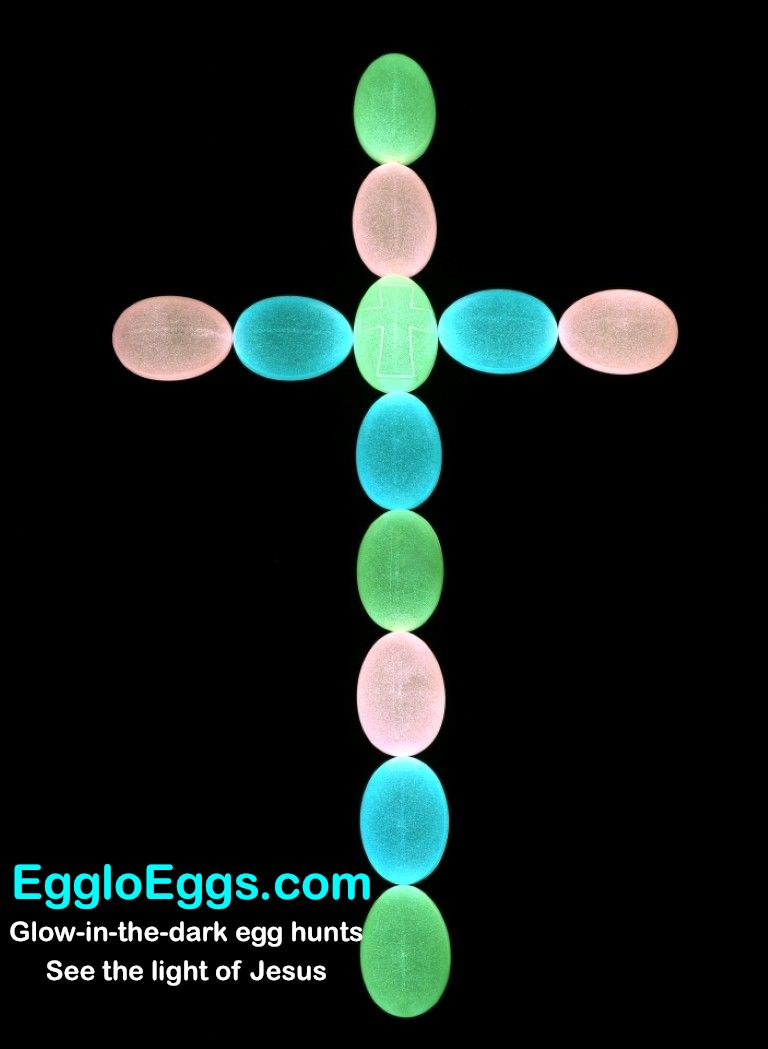
Glow in the Dark Egglo Eggs and The Great Easter Adventure book are fun and Christ centered.  The eggs either have a beautiful cross on them or are plain.  There are 12 in a box, consisting of four colors- blue, green, yellow, and pink.

What I received

  • A box (12 eggs) Glow in the Dark Egglo Eggs  ($11.99)
  • The book The Egg-cellent Easter Adventure ($12.99)
  • The Egg-cellent Easter Adventure audio download ($2.99)
  • Egglo Treasures Scripture Scrolls ($4.29)
  • The Egg-cellent Easter Adventure Program Guide ($14.99)

How we use the Program

Lexie and Max are both obsessed with eggs in general- Max likes to eat them, Lexie likes to crack them when we bake.  We have one little play egg, I am not even sure where it came from, but they both obsessively play with it.  Now that we have the entire set of glow in the dark Egglo Eggs, they like to go in the closet and watch them glow; we charge them several times a day!  haha

I overheard big sister telling the tot, “Now, this light is just like the light Jesus.”

I wasn’t really sure if they would be into hunting the eggs, but I laid them on the counter and let them “charge” under the light so they would glow really well.  The directions say to let them charge for about 30 minutes in direct sunlight, or 45 minutes under in-home lights.

So, we looked through the book (which in many ways was over Lexie’s 3 year old head, but was valuable non the less.  Then I hid the eggs in her room (we have blackout shades in there so it was nice and dark) while they waited in the hall.

*I cannot tell you how much fun they had hunting for these glow-in-the-dark eggs!*  But then, Lexie also understood the lesson of the glowing eggs, what they represent, and how they tie into Easter.  It was a win-win for us all!

hunting egglo glow in the dark easter eggs

(it was dark in her room, but the flash on my camera is on)

We may have hidden and found the eggs a dozen times the first day.   Quite possibly more.  She has asked to do them once a day ever since.  They are such a joy and I feel good about using them in our home.

After we tired out from the excitement of hunting the eggs, the kids enjoyed coloring some of the pages from The Egg-cellent Easter Adventure Program Guide.  There was something in there for both the kids to enjoy.  The program guide includes lots of valuable activities, fun snack recipes, and items to print to add to your Egglo Eggs.  It is also set up for both schools/churches and families.  I highly recommend purchasing it to accompany your eggs.

As part of my review, I received the scripture scrolls as well- we love these!  They take the eggs to a whole new level.  We put the scrolls inside our eggs before hiding them, and then after the kids found all the eggs, we opened each one.  Lexie thought it would be fun to choose a few scriptures as our memory verses for the coming weeks.  Max just liked to shake them inside the eggs and make music.  =)

Egglo Scripture Scrolls for Easter Eggs

Overall Experience

Our experience with the Glow In The Dark Egglo Eggs and The Egg-cellent Easter Adventure has been a positive one.  It was a great way to add a little more fun into our Easter celebration, and keep Christ in the center of it all.  Lexie understands the real meaning of Easter, and the little Mister is on his way to understanding too.  That is what this program is about- and that is why I can gladly suggest this program to anyone interested in doing an Easter egg hunt or celebration with their children.

Connect with Egglo Entertainment
 Egglo Review


Click to read Crew Reviews
Crew Disclaimer

Homeschool Spelling That Sticks! {with Memoria Press, a review}


Memoria Press has been a favorite curriculum in our home; we have enjoyed their Latin program. These last several weeks we’ve been using their Traditional Spelling II with great success and enjoyment! Memoria Press is a Classical Christian Education company that offers beautiful classical curricula and resources- they’re very well known in most homeschool circles.

All of my kids write notes and stories, or make books and cards what seems like all. day. long. Lady has been ready for more spelling focus in language arts, but because of a few struggles we needed something that included word study, application, and more intention on MY part. She is a vivacious reader, words and vocabulary are her jam, but at 7.5 years old, spelling … not so much! Piecing together ideas for practicing to go with other spelling programs just hasn’t cut it for us. That’s where Traditional Spelling II comes in!

Traditional Spelling II

This is a phonics based spelling program; it’s different than other spelling programs I’ve looked at or used. For us, Traditional Spelling II has taken exactly what we needed (phonics, routine/schedule, & activities) and applied it to spelling. Lessons include definitions, riddles, dictation, application, and color coding parts of words to create understanding of what one sees and hears to build the skill of spelling. It is to be used after a child has foundations in phonics/reading, and is for the grade 1, 2, 3 student. If you have used Memoria Press’s reading program, you probably alreday have some of the 4 required resources.

Included in our review are all required resources for Traditional Spelling II:

Just copying spelling words isn’t usually enough for most students; just as reading is so important for spelling ability, so is using and manipulating words, breaking them down and building them back like a puzzle, seeing the patterns, and practicing the vowel/consonant teams. This process which is used by Memoria Press is a multi-method approach to learning that is appropriate for young students-by using colors, dictation, riddles, and the other many word study activities, children learn using many methods of encoding!


How We Use It & What We Think

First- I cannot tell you how much we both look forward to our spelling lessons now, versus before. My daughter didn’t dread spelling before, it just didn’t stick, so she was disappointed when when couldn’t spell a words she knew she’d had in spelling. Knowing that each day we have activities laid out, ready and waiting on us, and helping my daughter encode at her level, has been a blessing for me. She enjoys the daily activities (some of which change weekly, keeping things consistent but fun), and it hits all areas of learning, allowing her to soak it all up.

Each Monday I begin by writing the words in sentences on the board, then we read them together and I go over their definitions (they will be used independently in sentences lasted in the week and thus students need to know the definitions). I pull out the phonics cards we need (card numbers are provided in the teacher’s manual for each lesson under “Teaching Overview“) and we talk about the sight words & spelling sounds, reading the words on the back of the cards that correlate with the sounds.

Memoria Press Lesson 7 Phonics Cards

The Classical Phonics book is a great phonetic resource; Lady likes flipping through this on her own for more “studying.” I’ve also been using it with my 3.5 year old for learning letter sounds; she loves it and asks for it almost daily! But the suggested use is for reading the words found within the book which follow that week’s spelling rules to increase fluency. I can give Lady the page numbers and she is able to look them up herself and read to me, creating independence and building confidence!

Next we begin the daily activities. The teacher’s manual lays out everything I need to do or say, gives card numbers for the Phonics cards, and page numbers for the Classical Phonics book. The Guided Student Work activities from the teacher’s manual are often different each day; these are done on days 1 & 2 and include riddles, filling in blanks of words, and other word practices offered each day. I either write them on my board or say them aloud and Lady writes the answer on her dry erase board.

The Teacher’s Manual is NOT overwhelming; what the teacher says is not paragraph after paragraph of mundane script. It is simple, to the point, consistent, fun, and EASY. The TM is only about as thick as the Student Book, so there is no extra “stuff” or script weighing down my part. I love this because scripted lessons can often feel boring and dry, but these definitely aren’t!

Each day after guided practice with me, she begins her student book activities which include: word sort under phonics focus (day 1), a fun/new word activity, plus the Colorful Letters activity (day 2), reading a paragraph and completing sentences (day 3), dictation word and sentence practice (day 4), and day 5 is the final “test.” Some weeks have different activities for Day 2, separate from the Colorful Letters activity- unscrambling, alphabetical order, sorting by syllables, circling word parts, etc. The various ways she uses the words keeps her interest and increases her ability to write them correctly. The other days’ activities are consistently the same, allowing more practice for important skills in encoding.

Workbook Pages Lesson 7, MP

We have been using the practice sheets as part of our handwriting/copywork. Lady is OBSESSED with cursive writing, so her student book having the cursive form of the words is a huge PLUS. She really likes to write the words in alphabetical order on her practice sheets, then write them in cursive- great meaningful practice (and all her idea).

MP Trad Spelling II

This isn’t a “write the words, take a test on Friday, and forget it next week” program. The lessons are fairly short, holding Lady’s attention, while also being intentional about how we spend our time.

I don’t want to fill our days with meaningless busywork- we need time for read alouds, tea parties, and playing in the dirt; raising chickens, and playing with baby farm animals. Short, focused lessons mean that we have more time to do all the other things we need to, and especially the things we want. I never considered spelling particularly fun in school, it was just something we did. But with Traditional Spelling II I feel like we have a purpose for spelling each week. The word study and a colorful letters portions really help us see the parts of words without too much “stuff,” required.

There are several other programs The Crew has been reviewing, you can see them on Memoria’s website here:

UnBoxing Traditional Spelling II MPress

Read more reviews by the Crew for many Memoria Press products by click the banner below:

Connect with Memoria Press:

Disclaimer: Some links on this blog are affiliate links; when you use those links you help support my family, at no additional cost to you.  Thank you!

DIY No Cook Play Dough

This is the easiest DIY play dough recipe I have ever made, and it is so soft! The play dough only has 3 ingredients that you are sure to have on hand.

This winter has been so frigidly cold, we’re in need other ways to meet all the kids’ sensory needs, so I am being more intentional this winter about sensory and messy play with my 4 children. Usually, all 4 are in the dirt, mud, flower beds, mixing flowers and leaves in buckets, and running barefooted.

Play dough can double as a good heavy work activity for children that need help self regulating, as well.

Easy DIY Play Dough


We like adding essential oils to our play dough for an added calming affect. After they explore with just the dough for a while, I let them have their rolling pins, dough stamps, and other tools. I also like to have them divide the dough into 10 balls, set up like a ten frame, then we do some hands on math!


Disclaimer: Some links on this blog are affiliate links; when you use those links you help support my family, at no additional cost to you.  Thank you!

Top Educational Toys for Toddlers-PreK

*original post May 2013, updated*

I am a teacher by trade, and a mama by … everything else.  =)  My husband and I try to keep educational/classic toys and books in our home, avoiding twaddle, and “junk” toys.

A fellow homeschooling (and dear) friend, and a few other readers have asked me what we use for toys in our house (I think my reputation for a toy nazi must precede me?!).  So I thought I would make an easy list of educational and fun learning toys that we enjoy or wish we had to enjoy.

These have really been a blessing in our home and homeschool- I know that seems ridiculous to say about “toys,” things that are material.  But they have really helped Lexie learn so much, often times on her own, or through questioning me.  Many things were gifts or bought with gift money from family and friends.  We are very grateful for their love and support.

This is a list that excludes puzzles, books, baby dolls, and toy trucks, etc-the general toys kids have aren’t on here.  I will do another post on those recommendations.  But I don’t think you would generally find many of these items in most homes.

These are not in a particular order, except the first one.  All the others Lexie plays with equally as much or in conjunction with the Magna Tiles.  haha

1. Magna Tiles!  You probably saw my post.  They are an investment … I know; I was nervous clicking the checkout button.  BUT, they’re amazing learning fun!  Last time I talked about them on here (the light table post) I wasn’t kidding about grabbing them for $120 with free shipping and the free book promotion.  That is no longer available, two weeks later.  I scoped theses things out for weeks to get that deal; but it sells out quickly.
2. Sorting bears– she loves them.  And they are great for her to play with during independent play.  They are good for learning and imaginative play-this set comes in 3 different sizes.  We read the three bears and then I introduced them.  She plays with them several days a week (if you get them, be sure to get the set with 3 sizes like the one in the link)
3. These basic pattern blocks get used ALL the time, for all different things.  They also make the pattern block cards that go with them, to use for more instruction type learning/play.  My younger children love using the pattern block cards independently while I school with my olders.
4. Unifix Cubes, or some sort of snapping cube.  Unifix cubes are great for building, sorting, counting, and learning about number sense, etc.  They’re a great math manipulative!  I linked to the 500 count set because 100 isn’t really enough.  When you get into complicated math down the road (multiplication, division, fractions) you will need more than 100 to compare amounts, makes graphs, etc.  So I’d suggest the larger set if you are able  (Especially if you will have more than one child using them at a time)
5. This letter construction set is Ah-MAZING.  I think I paid $25 w shipping (we have amazon prime, it’s worth it just for the shipping on Christmas gifts for family, alone!)  The set is a little more now.  The set is very strong, the pieces are big and wide so they’re easy for little hands to manipulate, and it’s fun.
This wasn’t a toy Lexie just jumped into- I let her explore with them first, then when she asked, I showed her what they were really for.  Now, a few years later, all of my children enjoy this set.
6. The Thomas Wooden Railway.  She loves it and uses it all the time.  We got the wooden one, and the wooden trains to go with it (we only have a few, but she seems happy with that for now).  I thought she would get frustrated with it, because the tracks have to be put together a certain way, unless you have enough track pieces then it doesn’t matter.  But she doesn’t.  She just pretends, takes it apart, can almost get it back together correctly… but often she plays with the trains without the tracks. **All 4 children now enjoy this train set, playing with the train tracks, and the trains. One of the first sounds baby #4 learned was “choo choo”
7. this shape sorter wooden clock by Melissa and Doug.  I know- it looks simple but it has seriously been on her table in the living room for over a year, and she plays with it almost daily.  We have used it for numbers, colors, and shapes.
8. Lexie learned her letters and letter sounds with foam bath letters and numbers like these (they were a gift for her first bday, I have no clue what brand ours are.  But they are a nice thick foam made for the bath tub, though they’ve never been in the tub…)
She lines them up, sorts them by color, stands them up (that takes some time and focus!) She still plays with them regularly.  They are one of the toys I don’t really rotate out. Our set came with numbers as well.  This is also how she learned her numbers.  I would just point to the letter/number and tell her its name and the sound it made.  Sometimes the most simple things are so great for learning! She has done the same with her younger siblings, teaching them on her own.
9. A small dry erase board and dry erase markers– my mom brought one for the trip from Memphis to NE when we moved.  Bug really likes it, but it isn’t something I let her have all the time (we are learning not to bang the marker on the board….)  The board is a small 12 x 12 board, great for playing, and learning to write.  The one linked has both a lined side, and a blank side; so as children develop their writing skills they can use the lined side.  We enjoy ours so far!
10. Her doll house– it is the fisher price loving family dollhouse, I had when I was a kid.  She plays with it all the time, and we play with it together.
11. water beads– you may have seen my post.  Cheap and fun (and they come in colors, too)!  They aren’t something we do every day, or even every week.  But Lexie LOVES them!  I think we may cover them in shaving cream for some extra sensory fun in the next few days.
12. Magnets– So much fun, so much learning and exploring.

13. Lacing cards– we have a few different sets of these from friends and family.  My kids use them often, they are something fun to do together as well.  They pretend to sew, knit, and crochet like mama.  Great for fine motor, critical thinking, and hand eye coordination.

14. Melissa and Doug Buckets– we have a few different versions of these- they are all VERY well loved, and have held up so to much abuse play. Living on a farm, outside toys like buckets get used on an almost daily basis and these have no disappointed! This is one toy that we can’t really have too many of.

15. ABC Bean Bags– I cannot count the ways we use these bean bags! One way, is by throwing them into those buckets I posted above. These have been so much fun for all ages in our home (7 down to baby). We toss, stack, count, hide, and tote around these bean bags daily. We also like our shapes bean bags and I plan to get the number bean bags eventually.

So, there are my top toys for toddlers through PreK children.  Of course always supervise your young children with any toy.

*This post contains affiliate links.  Thank you for supporting my site!  I was not paid or compensated in anyway for these opinions; they are my own.

Gingerbread Play Dough

I have been looking at a lot of different crafts for the kids and I to do together.  I came across a recipe for salt dough, which is a homemade play dough.  I had planned on trying it, then today my mom sent me a similar recipe, but there were two differences: 1) her recipe was for GINGERBREAD play dough and 2) it used fewer ingredients than the recipe I had.

Gingerbread Salt Dough
You will need:
  • 1c flour
  • 1/2c salt
  • cinnamon, nutmeg, all spice, etc to desired smell/color
  • 2tsp cream of tartar
  • 1c water
  • 1tsp veg oil
  • essential oils of your choosing

Just as in baking, mix all your dry ingredients together- the flour, salt, cream of tartar, and spices.  The spices are just for a great gingerbread smell and color.
In a separate bowl, mix the water and oil
Add water-oil mixture with your dry ingredients in a small/med pan.
Cook mixture over low/med heat for about 2-3 minutes, stirring frequently.  WARNING-it becomes thick quickly.
You will know it’s done when it starts to pull away from the sides and bottom of the pan.
When it’s done, knead on the counter until it is nice and smooth.
*don’t forget the cookie cutters and rolling pin!*

This is the best and easiest play dough recipe I have found.  When the holidays are over, exclude the seasonings and add regular food coloring for year-round fun!

——————
(Original post Dec 2011)
Here is Lady (15 months old) playing with play dough for the first time:

 She was really only interested in the cookie cutters at first .. and yes she arranged them in size order?
” Hrm .. maybe I will touch it a little”
She did not like the texture of the dough at the beginning.


More with the cookie cutters ..


Then I made her name out of the play dough and she liked it!  Her favorite letter from her name is “i,” so she enjoyed playing with the “ball” on the “i.”  When I spell her name out loud, it goes something like this:
Me- “l, e, x
her- “I!!  I!!! I!!! I!”
Me-E
her- “LEXIE!”

It’s a lot of fun!  So, our first go at play dough was a success.  There were a few snacking attempts, but overall she did really well!  This has made me less fearful of doing more crafts and activities with her, for sure!

Try it out with your little one!

What are some of your children’s favorite activities, crafts, etc to pass the time and learn?

Digital Science Online {a review}

The last several weeks we have been enjoying Visual Learning Systems in our homeschool.  We have used Digital Science Online: Elementary Edition (Grades K-5) for our science studies; the Review Crew members were given full access to all levels for Admin, Teacher, and Student accounts.  We used the Elementary Edition, because at 4 years old that fit Lexie best.  But Crew members were given access to Digital Science Online: Secondary Edition (6-12) also!

Using Digital Science online {video based learning science curriculum}

About Digital Science Online

The elementary edition of Digital Science Online is an annual subscription service ($99/year) to science videos and clips, animations (showing how things work), images, student sheets and teacher’s guides.  It is divided into two grade levels, actually- primary, and elementary.  The primary grade level includes the following subjects:

  • physical
  • earth
  • life
  • health

While the elementary level covers:

  • physical
  • earth
  • life

Both primary and elementary levels cover a wide range of topics included in over 136 units of study combined!  The curriculum does meet state standards, if that is a concern for your family.  The videos are indexed and searchable using keywords, which I love because no matter what we are discussing I am able to do a quick search and find just what I need.  Videos are only about 6-20 minutes long (at longest) and are available anytime, just log in!  Everything is in one place, on one screen, which is so nice for me and very easy to navigate.  Digital Science Online is a very clean interface, and simple to navigate, which is especially great for students working independently.  Lexie isn’t quite old enough to work independently on the computer, but had we used this on the ipad I have feeling she could have done it on her own!

The videos themselves are clear and broken into segments allowing the student to answer questions on their student sheets.  Each video has a teacher’s guide section; here you will find: an introduction to the lesson, the student activities, learning objectives, and the script to the video (so if you need to help with a student sheet, you can skim the video or the script).

Each video’s student sheets include: What Do You Know Now?, What Have You Learned?, Video Review and Quiz, and then a few specific lesson-related worksheets.  Some include diagrams (very cool!) while others are instructions for hands-on activities.  There are a lot of hands on activities included in the program, so this is great for those visual and kinesthetic learners!

Our favorite so far has been the “Your Body” lesson, from the health subject under primary.  A few of the hands-on activities include: tracing your body and drawing in the organs, drawing in healthy foods on your plate, using magnets, taking soil samples, and dressing a paper doll (weather).  There are many more, too many for me to cover here!

VLSHomeschool_zpsfl91k3kp

 How We Used It, What We Thought

I did need to modify how we used the student resources because Lexie is only 4.5 (but does mostly Kindergarten work).  I simply did the teacher’s guide introduction with her (and tag-along little brother) before we watched, so she knew what we were going to be learning about.  Then we went over video quiz and pre-assessment pages together, orally.  While we watched the video, I wrote down her responses to the questions (dictation) for her, since her writing skills are not yet developed enough for so much writing.  This was great dictation practice for her.

For the post-video assessment I let her elaborate as much or as little as she wanted on what we discussed.  She was so proud of herself when she answered questions in the video correctly (and she usually did).  Little brother (2.5 years old) loved tagging along, and thought everything was so interesting.  The videos kept both of them engaged, and they were able to really tell me about what they learned; provided they were on two different levels, but Max being able to apply wind in his ear makes his ear “wiggle,” aka vibrate, inside is pretty cool!

A few things I really liked about Visual learning Systems

  • It is straight forward- no fluffy stuff or crazy cartoon characters that distract, but is still interesting to young children (including my 2.5 year old)
  • It is clear, concise, and factual- we were able to easily understand what was being said in the video because the voice over spoke clearly, images were clear, and animations were very easy to understand.
  • Interaction- the children are able to/need to interact during the videos- the videos have stopping points, and the student sheets kept my daughter engaged.

If you are a homeschooling family looking for a no-fuss, simple but complete visual/video-learning based science curriculum, look no further!  This is a good program, and we will enjoy using it for the rest of the year!

Connect With Visual Learning Systems

More Reviews Banner


TOS Disclaimer

{easy} Oven Roasted Pumpkin Seeds

oven roasted pumpkin seeds (so easy!) {Quiet In The Chaos}

If you are like me, you *love* fall.  I love everything fall- apples, pumpkins, leaves- and now I can add roasted pumpkin seeds to that list.  These were a lot of fun, and are packed full of nutrition.  The best part is you can involve the kids in the hardest part of the work, getting the seeds out of the pumpkins!  =)  We used it as sensory play, letting them get messy and having a big time!

Here’s what you need to do:

1. cut tops off the pumpkins and scoop out the seeds

oven roasted pumpkin seeds (so easy!) {Quiet In The Chaos}

2.  Rinse the seeds well in a colander.

oven roasted pumpkin seeds (so easy!) {Quiet In The Chaos}

3.  Bring seeds to a boil, then turn down the heat and simmer for 10 minutes (don’t forget the salt for flavor!)

oven roasted pumpkin seeds (so easy!) {Quiet In The Chaos}

4.  Preheat oven to 400 degrees.  Now drain seeds.  Place in a bowl large enough to toss well.  Toss with olive oil and salt (and any other seasonings you may want to add)

oven roasted pumpkin seeds (so easy!) {Quiet In The Chaos}

5.  Spread evenly on a baking sheet and bake at 400* for 5-20 minutes.  Ours took about 20 minutes, and we flipped them every 5-10 minutes to get the entire seed toasted.  They are so good.  We got seeds from two pumpkins (it would have been 3 but the tot threw the seeds from one pumpkin all in the grass..) and it was plenty of seeds!

oven roasted pumpkin seeds (so easy!) {Quiet In The Chaos}

Your seeds really need to be more spread out than this … we were just a little lazy. They still turned out good!

And that’s it!  This was very easy, and is a great way to let the kids help while learning and playing. We eat on them as snacks, and I plan to use them in a granola recipe.  Yum!

What is your favorite fall snack?

Pumpkins & Fall for Tots and Preschoolers

Autumn-Homeschool-Studies

Having a 4 year old that begs for learning time can be a challenge with a two year old all-boy toddler literally running around, and a 5 week old baby in the house.  So when it comes to our themed and “extra” activities, I like to try to find things they can do together.  That way if Mister doesn’t really want to participate it is okay, but he is able to if he would like.  This month we are studying pumpkins.  While Lexie is ready to learn what kind of plant a pumpkin is, and how a pumpkin grows, Mister’s activities are much simpler.

Max (2) will be learning and focusing on:

  • the letter “P”
  • the color orange & coloring pumpkins by following instructions
  • Completing a “My Pumpkin” book (color, cut, and glue) from www.ThisReadingMama.com
  • Gluing/matching pumpkin shapes (from www.1+1+1=1.com)
  • Count the Pumpkins (also from www.1+1+1=1.com)
  • P is for Pumpkin do a dot (also from www.1+1+1=1.com)
  • reading (his favorite poem) Peter, Peter, Pumpkin Eater
  • words (non sense included) that rhyme with pumpkin
  • textures of pumpkins (smooth, bumpy, etc)
  • introduce why leaves change color in the fall
  • Reading pumpkin/fall books

Lexie (4) will be learning and focusing on:

  • how pumpkins grow
  • what kind of plant pumpkins are
  • words (non sense included) that rhyme with pumpkin
  • Completing a “My Pumpkin” book (color, cut, and glue) from www.ThisReadingMama.com
  • Counting pumpkins math sheet (we will use unifix cubes to add hands on) from www.1+1+1=1.com
  • Pumpkin number match book (from www.childcareland.com)
  • Pumpkin Syllable Count and Clip (from This Reading Mama)
  • introduce why leaves change color
  • reading pumpkin/fall books

Now, obviously all of these activities aren’t solely focused on fall; many of them just include pumpkins.  But at this age especially, I am following my children’s lead as to what interests them.  Lady loooves “worksheet” type activities, cutting, pasting, assembling books, etc.  Mister … well, he is just being introduced to activities and learning time, so I am still trying to find what he loves to do.  Also, many of their activities overlap; I will modify and adjust as needed for Max.

Hopefully we will be making a trip to the pumpkin patch soon.  We spent some time playing in pumpkins last week.  This was great sensory play for tots and preschoolers- they had fun digging out the insides and sorting the seeds.  We then roasted the seeds for yummy snacks (which they ask for constantly).  I plan to use some of the roasted pumpkin seeds in granola as well.  We talked about how the pumpkins felt- were they rough, smooth, smushy, hard, etc.

Pumpkin Sensory Play {Quiet in the Chaos}

This unit has been a lot of fun so far, and I suspect it will be a lot more fun as we continue through it in the month of October.  I was hoping to get more of the activities and lapbooking done before this post went up, but life got in the way.  Hopefully I can bring you a post full of completed activities and lapbooks in the coming weeks!

KinderBach: Online Piano Lessons for Children {a review}

Kinderbach Review
In recent weeks we have been so blessed to have had the opportunity to try and use a beginner piano program for our three year old daughter. The KinderBach Online Piano Lesson Membership with Teacher Corner, is a wonderful program for young children to learn the basics of playing piano (whether they’re learning on the Amidio piano VST or an organ). Each lesson is set up to be only a few minutes (perfect for young children). Lexie loved it so much, we couldn’t only do one lesson. We did several lessons at a time.

Now, I actually have something to compare this with as well, as we recently enrolled Billy through private piano lessons san francisco. I’m interested to see what he preferred the best.

Kinderbach Review

All About KinderBach Membership with Teacher Corner:

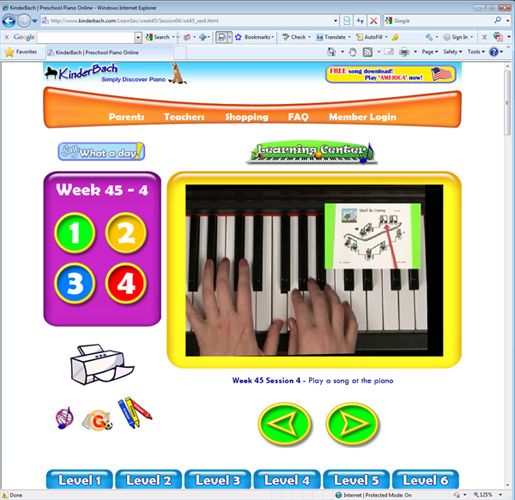
One of the great things about the KinderBach Online Piano Lesson Membership with Teacher Corner is the ease of use for parents and children. It is ideal for ages 3-7, but I can see using this with older children as well, because you can skip some of the lessons, and go at your own pace! You will receive:

  • Access to all web lessons (over 240 sessions) by computer, iPad, Android Tablet, Kindle Fire, or Nook.
  • Accompanying downloaded PDF activity pages- these are great!
  • Access to all Teacher Corner materials for Levels 1 to 6 PDFs and Audio MP3s
  • Download all story books, coloring pages and song books

So, what is the Teacher Corner? The Teacher Corner membership gives you everything needed to teach group music lessons and more in convenient digital downloads. You can have your books right now (and they’re included in the price!). Choose from over $400 worth of books in the Teacher’s Corner and more will be added soon. You never have to pay more for a new edition. Membership gives you the opportunity to download all updates.

You will get all of that for $95.88/year which is $7.99 a month. There is no way you can find a piano teacher for $7.99 a month, plus purchase any necessary books and music. All of that will be included in your membership!

Online piano/keyboard lessons: KInderBach

What You Need

There are a few things you will need for KinderBach online piano lessons:

  • A piano or keyboard- yes, you can use a regular ole keyboard! If you need help finding a good one to use then check out this yamaha p115 review
  • A few things from around the house- wooden spoons, empty cartons, plastic lids- anything really. No need to get fancy!
  • A printer is helpful- with a printer, you can print your digital books and activity sheets.

What I Love About It

First and foremost, my favorite part of KinderBach is that is truly is child friendly! My 3.5 year old did great doing these lessons on her own. She was even able to tell her violin teacher a thing or two about the piano! She especially enjoyed the rhythmic exercises, and so did her 18 month old brother. It was something they were able to enjoy doing together, and learn at the same time. Obviously the tot didn’t get as much from it, but hey- he can now hit sticks together in rhythm! =)

Online piano lessons ages 3-7 KinderBach

We used the website on our iPad, which made it very easy to set up right in front of our keyboard (after doing some research and using sites like https://www.revitalizingdowntowns.net/, we did settle on getting a keyboard rather than a piano, it’s absolutely the best fit for us). Because KinderBach accommodates all formats, chances are you own a device it is compatible with. The lessons include songs and music your family is probably familiar with, which help teach parts of music such as: different kinds of notes, different keys on the keyboard, and how to keep rhythm. It is very developmentally appropriate for children, as it allows them to move about and does not require they sit at a piano the entire time (or at all, really).

For me the parent, I can pick and choose what books we use, how fast we go, and how often we do it. This was something we used about 3 times a week, and often did 2-3 lessons at a time, because Lexie enjoyed it so much. We will continue using it in this way. Just before we began these lessons, my husband mentioned putting her in piano lessons, along with the violin lessons she already loves. Lexie loves music, and loves instruments. KinderBach has turned out to be the perfect combination of fun, easy (for the teacher), and developmentally appropriate, for our family!

piano lessons ages 3-7 KinderBach with Teachers Corner

Connect with KinderBach:

Click to read Crew Reviews
Crew Disclaimer

Shaving Cream Play

While it was still cold and snowy, we had a lot of fun with shaving cream.  This is from the first time we did shaving cream in the new house; we have fun adding toys (mainly engines) into the shaving cream fun.

I moved her little table from the living room to the kitchen.  When she got up from nap, this is what she found:

She was one happy girl that afternoon!  She loves any type of messy play.  She squeezed and squished the shaving cream between her fingers.  She especially loved the scent (menthol) of it.

It is super easy to clean up off the floors, and of course to rinse off her.
We do shaving cream play a lot- it is a favorite of Lexie’s (and mama’s too, because there is no mixing or recipe to follow)!

What is your favorite messy play?

error: Content is protected !!
Verified by MonsterInsights